Apple
sightmap atlas add appleEditorial product pages and the configure-and-buy store, two systems sharing one header, plus a 404 that changes language with the URL.
Views
| View | Route | Components | Requests |
|---|---|---|---|
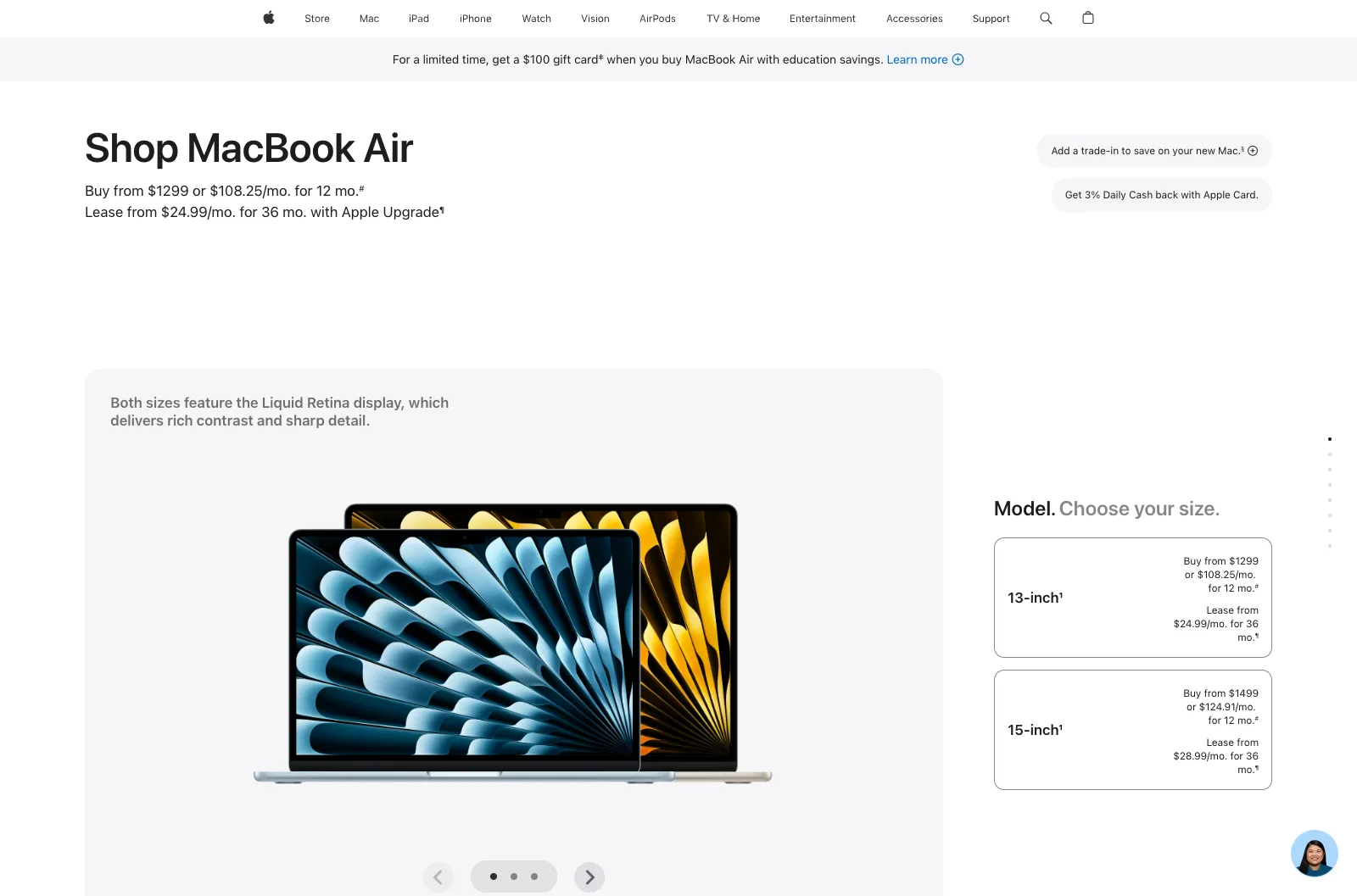
| BuyFlow | /**/shop/buy-mac/:model | 16 | 3 |
| Home | / | 7 | 0 |
| NotFound | /** | 4 | 0 |
| ProductMarketing | /:productSlug | 10 | 2 |
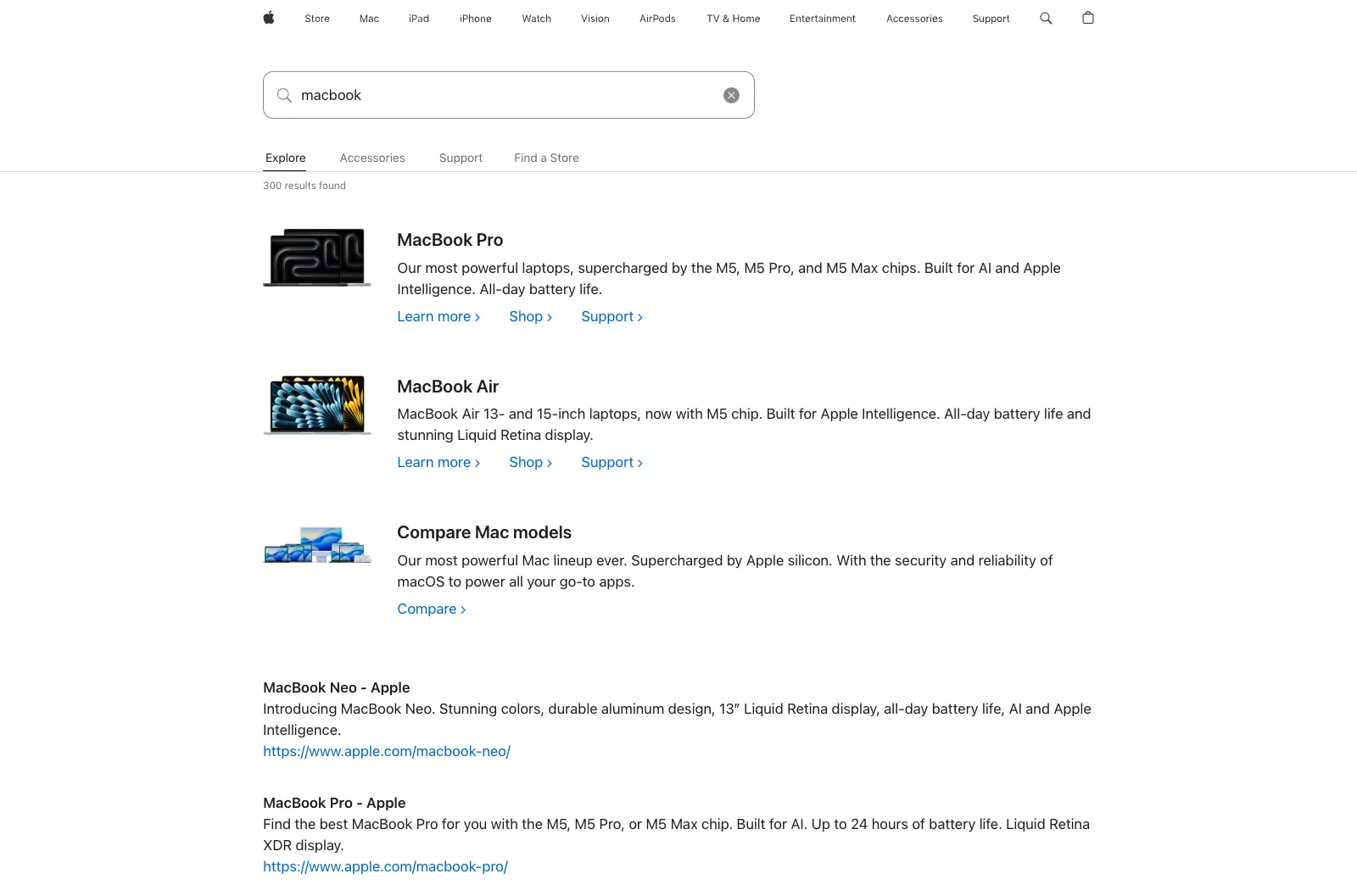
| SearchResults | /:locale/search/:query | 7 | 1 |
Apple
apple.com, mapped as a signed-out visitor.
Coverage
| View | Route | What it holds |
|---|---|---|
Home |
/ |
Promotional tiles and a media gallery |
SearchResults |
/:locale/search/:query |
Tabbed results across four verticals |
ProductMarketing |
/:productSlug |
Local nav, marquee, scroll galleries |
BuyFlow |
/**/shop/buy-mac/:model |
Stepped configuration with a running price |
NotFound |
/** |
Apology, search box, sitemap link |
GlobalHeader, NavCurtain, PageRoot, MainRegion, AnnouncementPortal,
NavSearchResultCount, and GlobalFooter are global. All five views report
0 orphaned coverage, with every selector sel-probed on 2026-08-07.
Hazards
The 404 changes language with the URL. The first path segment is a locale
code, so /fr/nope-xyz returns "Page introuvable", /no/nope-xyz returns
Norwegian, and /zzz/nope-xyz returns English. An agent that detects errors by
matching the message text gets a different string depending on a path segment it
may never have chosen deliberately. Match on structure instead.
A single-segment unknown path is indistinguishable from a product page.
Marketing pages live at /:productSlug, so /no-such-page has the same route
shape as /macbook-air. The structural tell is #ac-localnav, which every
marketing page carries and the error page does not.
Marketing pages cannot sell anything. /macbook-air/ is editorial — a
starting price and a link, with no configurator and no add-to-cart. The purchase
surface is /shop/buy-mac/macbook-air. These are two different systems sharing
one header, and confusing them is the easiest mistake on this site.
Most store URLs you find by crawling are aliases. There is a permalink layer
at /us/shop/goto/ using underscores that redirects to the hyphenated canonical
route. The home page alone carries over a hundred of them.
Two ids for one footer. #ac-globalfooter on the landing and marketing
pages, #global-footersection on search and the store. Matching only one finds
the footer on about half the site.
Buy-flow options are ordered steps, not fields. Later steps depend on earlier ones, so a configuration cannot be filled in arbitrary order. The sticky bar carries the running total, which diverges from the header's starting price as soon as anything is selected.
Ids that are not addressable. React useId produces #_r_3_ for search tab
panels and #announce-message-_r_8_ for the nine live regions inside #portal.
They change per render and are not valid CSS identifiers unescaped.
Marketing pages are enormous and video-driven. /macbook-air/ is roughly
28,000 pixels tall, with paired -startframe- and -endframe- images standing
in for video until it plays. A snapshot at the top captures placeholders.
Known gaps
The buy flow is mapped through configuration and stops before the bag. Going further means starting a real purchase.
Apple Account, order status, and anything behind sign-in are out of scope per docs/POLICY.md.
Only the US locale is mapped. Since the first path segment selects locale, other markets serve different prices, availability, and copy from the same structure.
ProductMarketing and BuyFlow are each pinned to one product. The rf-bfe-
and .section vocabularies hold across the range; which steps and sections
appear does not.
SearchResults was mapped on the Explore tab. The other three tabs
(Accessories, Support, Find a Store) use the same shell and were not populated.
Screenshots
Signed-out views of public pages.