eBay
sightmap atlas add ebayMarketplace search, category browse, item detail, and the live-shopping hub, mapped as a signed-out shopper.
Views
| View | Route | Components | Requests |
|---|---|---|---|
| CategoryBrowse | /b/:categoryName/:categoryId/:browseNode | 17 | 2 |
| Home | / | 6 | 0 |
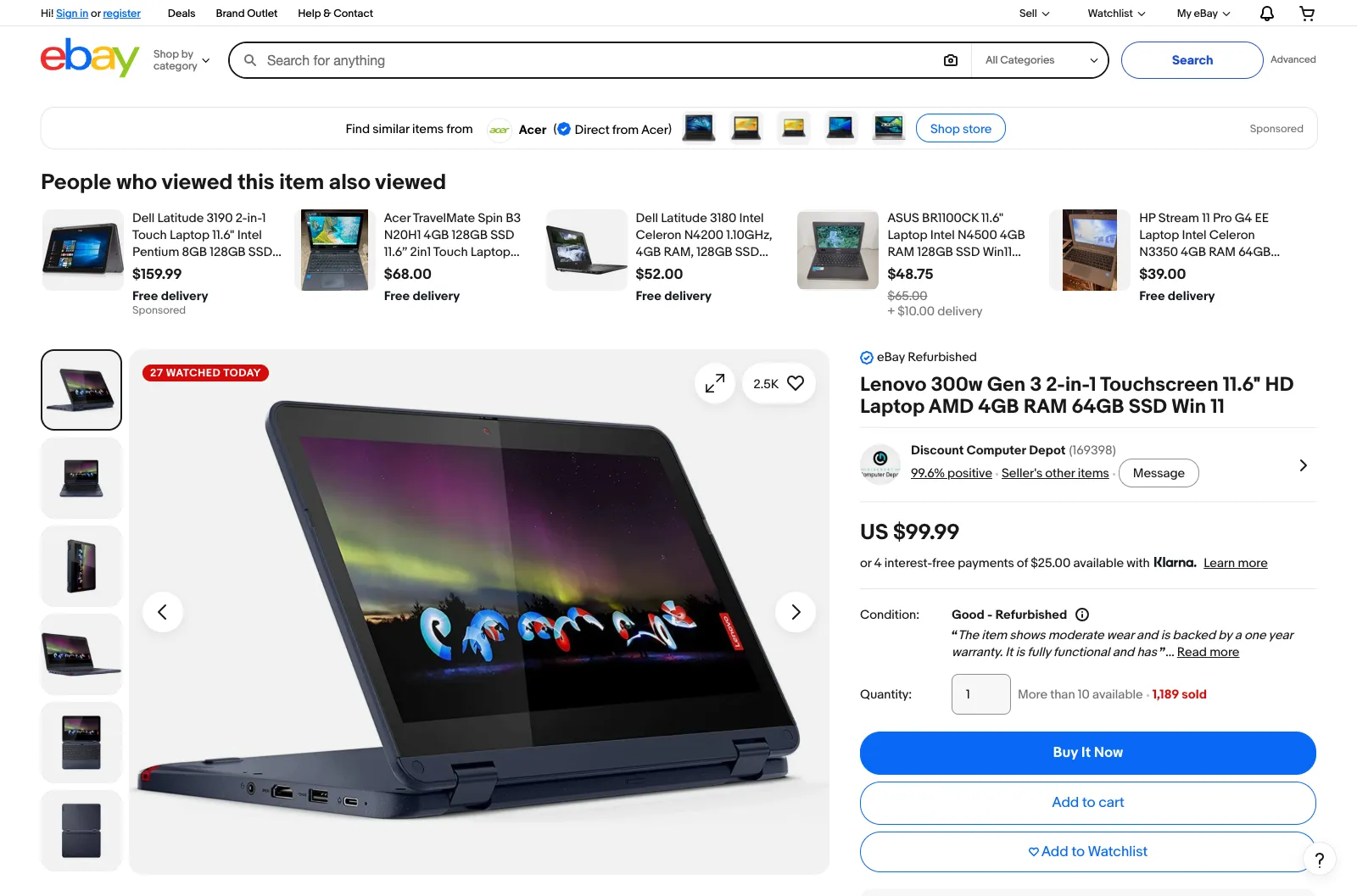
| ItemDetail | /itm/:itemId | 12 | 0 |
| LiveHub | /ebaylive | 3 | 0 |
| NotFound | /** | 2 | 0 |
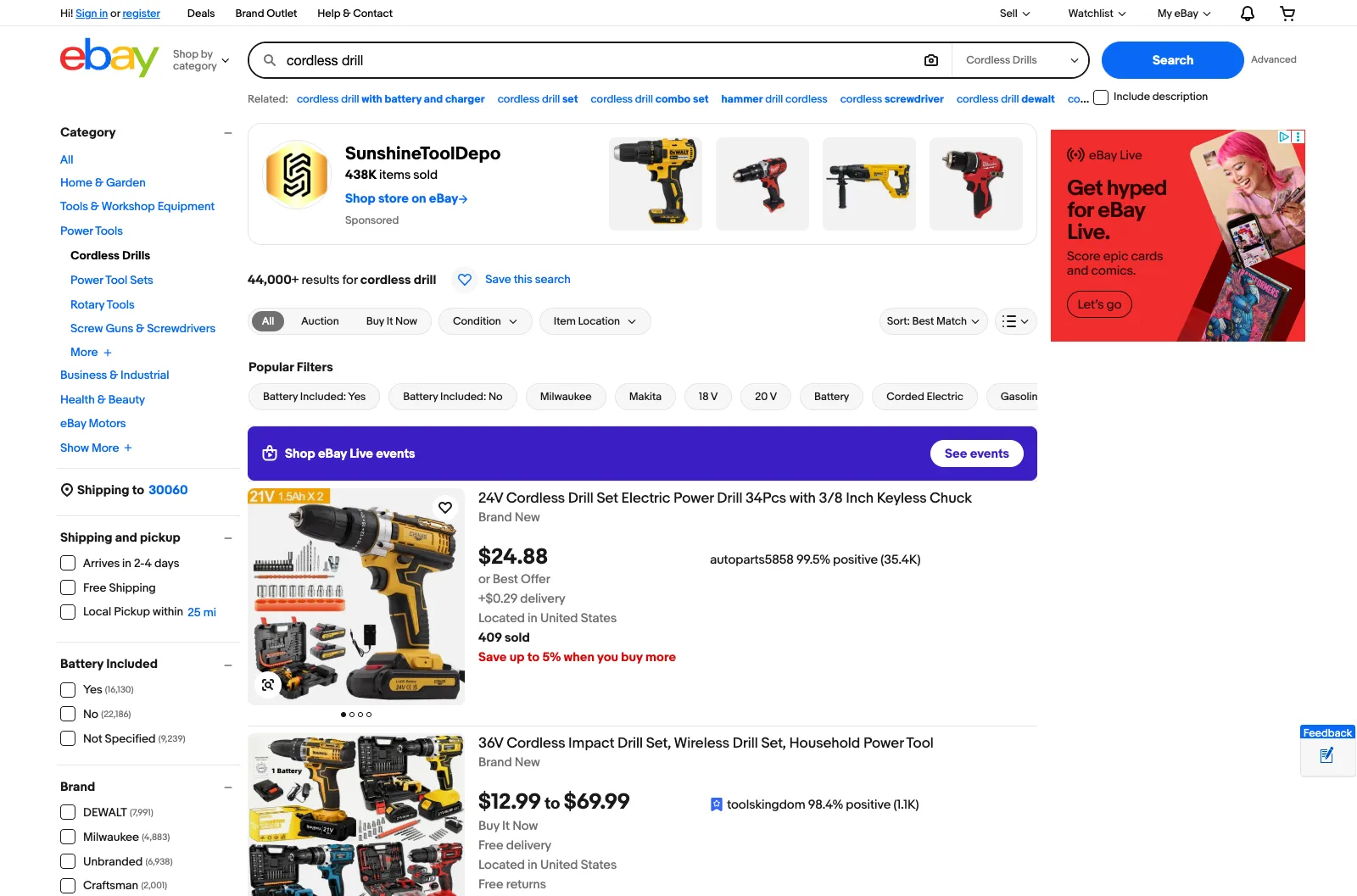
| SearchResults | /sch/i.html | 21 | 2 |
eBay
Everything an agent can reach on ebay.com without an account: find something, narrow it down, and read the listing.
Coverage
| View | Route | What it holds |
|---|---|---|
Home |
/ |
Category flyout, live-shopping carousel, rotating promo modules |
SearchResults |
/sch/i.html |
Filter rail, result river, sort and pagination controls |
CategoryBrowse |
/b/:categoryName/:categoryId/:browseNode |
Breadcrumbs, category tree, refinements, item grid |
ItemDetail |
/itm/:itemId |
Gallery, title, price, quantity, buy actions, shipping, returns |
LiveHub |
/ebaylive |
Filterable feed of live and upcoming shopping streams |
NotFound |
/** |
Catch-all error page |
GlobalHeader, GlobalFooter, GlobalPromoBanner, and FloatingHelp are
global components. All six views report 0 orphaned coverage, with every
selector sel-probed on 2026-08-06.
Hazards
A category URL can lie about which category you are on. The name segment in
/b/:categoryName/:categoryId/:browseNode is decorative.
/b/Totally-Made-Up-Name/220/bn_1865497 loads Toys & Hobbies and quietly
rewrites the path to the canonical name. A mismatched name and id pair is worse:
/b/Cordless-Drills/184644/bn_1853799 serves Porcelain Nativity Items with a 200
and no warning at all. Read .textual-display after the page loads; the URL you
requested proves nothing.
Three surfaces list products and no two share a card class. Search uses
li.s-card, category browse uses .brwrvr__item-card, promo carousels use
.brw-product-card, and eBay Live uses .dp-subgrid-item. There is no single
card selector, and reaching for one is how a scraper silently returns nothing on
half the site.
Scope result cards or overcount them. The bare .s-card class also matches
sponsored and related-item cards sitting outside the results list, so
ul.srp-results > li.s-card is the selector that returns the 60 results the page
actually has. The same applies to a.s-card__link, which matches once per
carousel thumbnail and lands near 150 on a 60-result page until you exclude
.image-treatment.
Filter group ids are positional and shift with the query. #x-refine__group__0
through __8 are assigned in render order, so the price group is not reliably
group 4. Match on the .x-refine__item__title heading text instead. Buying
Format, Condition, and Item Location are not in the left rail at all; they render
as menus in the controls bar.
Class names split into two families and only one is safe. Prefixed names
(gh-, srp-, brw-, x-refine__) are structural and survive deploys. Bare
short names like .esJT, ._5hsT, and .Jd4g are compiled output. So are the
home page's s0-0-1-1-0-2-…-container ids, which encode a module's position in
one particular render.
A cold profile gets a proof-of-work splash first. The first request lands on
/splashui/challenge, the browser answers it with argon2.wasm, and then the
real URL loads. Nothing is required of the agent, but the first page is slower
and document.referrer points at the challenge rather than wherever you came
from.
Known gaps
Cart and checkout are mapped only as far as the buy-box buttons on
ItemDetail. Going further means adding items to a cart and moving toward a
purchase on a live marketplace, which is not something a map should do to
someone else's storefront.
Signed-in surfaces (My eBay, Watchlist, purchase history) are out of scope per docs/POLICY.md. The header links to them from every route, so an agent following the global nav will hit a login wall there and nowhere else.
ItemDetail is pinned to one real listing, and listings end. When that URL stops
resolving, re-probe against any current /itm/ id; nothing in the view depends
on that particular item.
Screenshots
Both are signed-out views of public catalog pages. The search screenshot shows a "Shipping to" ZIP that eBay inferred from the capture machine's IP address, which is the store's regional default rather than anything a visitor entered.