UNIQLO
sightmap atlas add uniqloUS storefront — category listings, product pages, search, and an error page with a real address.
Views
| View | Route | Components | Requests |
|---|---|---|---|
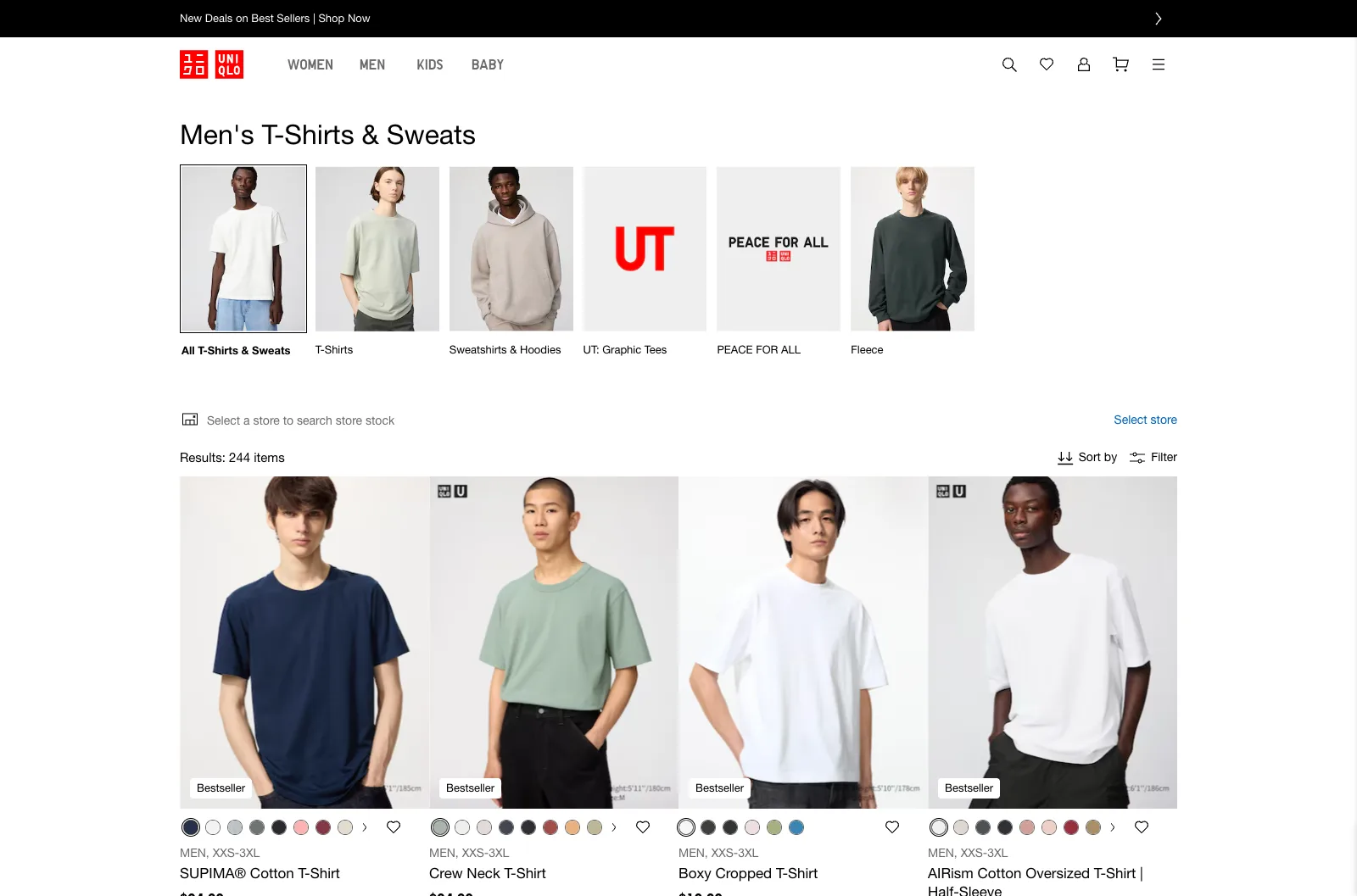
| CategoryListing | /us/en/:gender/:category | 6 | 1 |
| Home | /us/en/:gender | 3 | 1 |
| NotFound | /us/en/not-found | 1 | 0 |
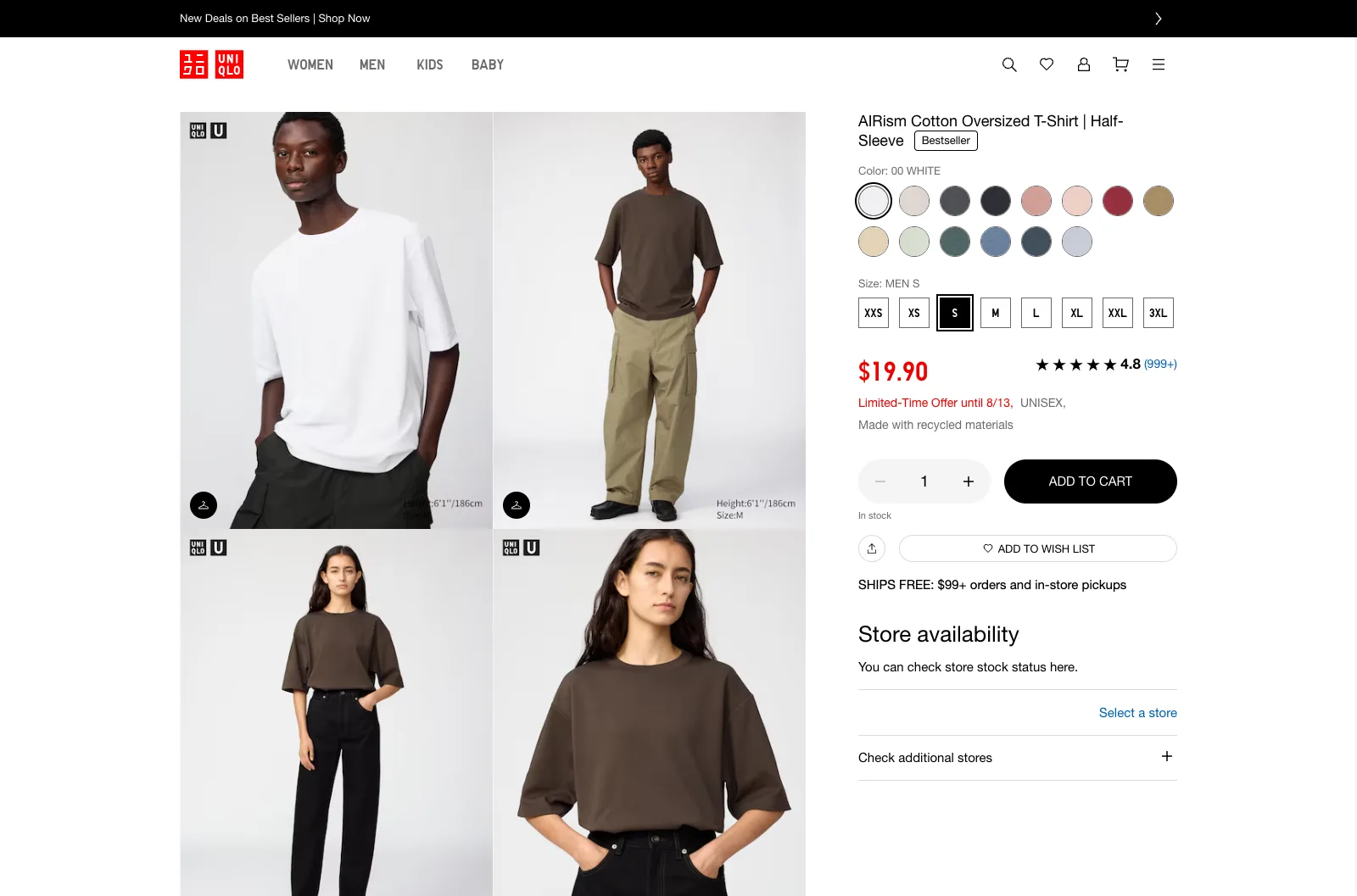
| ProductDetail | /us/en/products/:productId/:colorCode | 3 | 8 |
| SearchResults | /us/en/search | 5 | 2 |
UNIQLO
The US storefront (/us/en/), mapped as a signed-out shopper.
Coverage
| View | Route | What it holds |
|---|---|---|
Home |
/us/en/:gender |
Media banners and a category grid |
SearchResults |
/us/en/search |
Product tile grid |
CategoryListing |
/us/en/:gender/:category |
Sticky subcategory tabs above the grid |
ProductDetail |
/us/en/products/:productId/:colorCode |
Gallery, options, size table, related products |
NotFound |
/us/en/not-found |
Error page, reached by redirect |
PromoStrip, NavigationHeader, PageContent, Breadcrumbs,
PreloadedDialog, BackToFrontOverlay, Accordion, PromoModal,
ContentAlignment, ECGrid, Drawer, PopupFormDialog, AppShell, and
GlobalFooter are global. All five views report 0 orphaned coverage, with
every selector sel-probed at authoring and re-verified against the live site
on 2026-08-08.
Reliable signals
The page type is a class on the content root. .fr-ec-template-plp is a
category listing, .fr-ec-template-pdp is a product page, .home-template is
the landing page. An agent can branch on this instead of parsing a URL.
The error page has a real address. An unmatched path redirects to
/us/en/not-found, so location.pathname answers "did I land on an error page"
with no DOM inspection.
Hazards
The data-testid values are design-system primitives, not identifiers.
ITOTypography matched 574 elements on one page, ITOImage 363, ITOLink 128.
They tell you an element is a piece of text and never which one. Use the
fr-ec- classes for identity and read ITO* as type information.
The landing page has three addresses and state decides which you get.
/us/en/ redirects to whichever gender was browsed last, /us/en/men keeps its
path, and /us/en/women normalizes to /us/en/. The preference is stored
client-side, so two agents at the same URL land on different pages. This map
anchors on /us/en/:gender because that is where a warm profile actually ends
up.
The navigation renders three times. Desktop, mobile, and sticky variants all sit in the DOM, so any count of nav links is tripled.
Three empty overlay hosts ship on a browse route. ITODialog,
.b2f-overlay, and the POPUP Form dialog are all present and empty before
anything opens them, so counting dialogs overstates what is actually showing.
Breadcrumbs are at the bottom. [data-testid="ITOBreadcrumbGroup"] sits at
the foot of the page, not above the content.
A product URL grows after loading. Requesting
/us/en/products/:productId/:colorCode appends ?colorDisplayCode= and
?sizeDisplayCode= for the default variant, so the URL after load differs from
the one requested even on success.
Known gaps
Cart, wishlist, and checkout are out of scope; the map stops at the product options.
Accounts and anything behind My Account are out of scope per docs/POLICY.md.
ProductDetail is pinned to one colourway, since colour is a path segment rather
than a parameter.
Only the /us/en/ storefront is mapped. The locale prefix is part of the path,
so other markets have their own catalogue and prices.
Screenshots
Signed-out views of public catalog pages.